
Staying Employable in an AI-Led Economy: A Report for Workers in High-Risk Jobs
Artificial intelligence is reshaping global labour markets, with credible forecasts suggesting that between a quarter and a third of current work activities could be automated by 2030 in advanced economies. Estimates from the OECD indicate that around 27–28% of jobs in OECD countries are at high risk of automation due to a high share of easily automatable tasks. At the same time, the World Economic Forum (WEF) finds that 44% of workers’ core skills will change within just five years, underlining that disruption will affect not only whether people are employed but how they work and what they must be able to do. The central message of this report is that while many roles are at risk, individuals who reposition themselves—by adopting AI, upgrading skills, and shifting towards more human-centric, higher‑value activities—can remain employable and even gain advantage in the emerging AI-led economy.
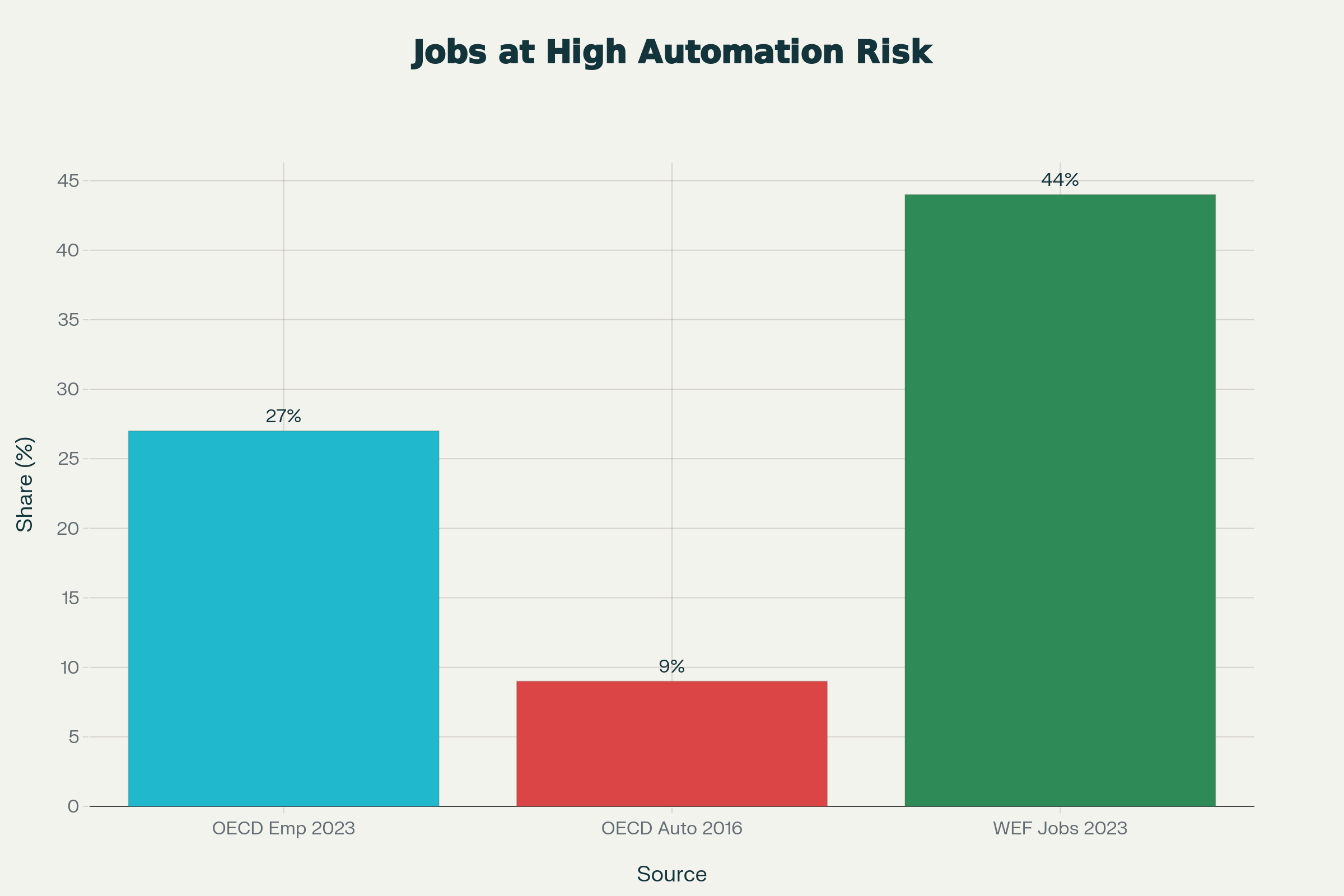
Selected estimates of automation and skills disruption risk from major studies
1. The Scale and Nature of AI-Driven Job Risk
1.1 Evidence on Jobs at Risk
Multiple reputable studies converge on the view that a significant minority of jobs are at high risk of automation, with a much larger share substantially transformed:
- The OECD’s 2023 Employment Outlook and subsequent briefings estimate that jobs with a high risk of automation—defined as those where more than a quarter of required skills are easily automatable—account for about 27–28% of jobs on average across OECD countries.
- Earlier task-based analysis by the OECD using the PIAAC database found that around 9% of jobs are highly automatable, noting that occupation-level estimates such as Frey and Osborne’s 47% figure overstate risk by ignoring within-occupation task variation.
- McKinsey modelling for Europe and the United States finds that up to 27–30% of current hours worked could be automated by 2030, accelerated by generative AI, implying millions of occupational transitions.
- The WEF’s Future of Jobs 2023 report and subsequent summaries indicate that technology is the single largest driver of job change, with companies expecting substantial churn: simultaneous job loss in some occupations and job creation in others.
These findings suggest that while full job elimination may be lower than early headline numbers implied, task-level disruption is large and pervasive, forcing workers—especially in high-risk roles—to adapt rapidly.
1.2 Who Is Most Exposed?
Evidence consistently shows that risk is not evenly distributed:
- The OECD notes that workers in jobs with the largest shares of automatable tasks are disproportionately low-skilled, younger, and male, often in clerical, routine service, and manual roles.
- Analyses of automation exposure highlight clerical and routine cognitive jobs—such as bookkeeping, payroll, basic data entry, and standardised customer support—as particularly vulnerable.
- Emerging research on AI task susceptibility indicates that high-skilled non-routine analytical roles are also increasingly exposed, as generative AI can take over substantial portions of knowledge work, though often in an augmenting rather than fully substituting way.
At the same time, WEF and McKinsey highlight strong growth in STEM, healthcare, the green economy, and high-skilled professional roles, and an overall net job creation when new categories are included. This reinforces that the core challenge is not absolute job loss but transition and reconfiguration, with risk concentrated in specific task profiles rather than entire sectors.
2. Strategic Framing for Individuals in High-Risk Jobs
2.1 Task Automation vs Job Redesign
The International Labour Organisation (ILO) and other global analyses of generative AI stress that the predominant impact is likely to be augmentation of most jobs, with full automation limited to a smaller subset of roles where entire task bundles are routine and codifiable. McKinsey’s 2023 AI survey similarly finds that businesses expect more reskilling and role reconfiguration than outright headcount reduction, except in a few functions such as basic service operations.
For workers, this implies a critical shift in mindset:
- Instead of asking, “Will AI take my job?”, the more actionable question is, “Which of my tasks are most automatable, and how can I move into tasks where I add unique human value while using AI as a lever?”
- Individuals who proactively help redesign their roles around human‑AI collaboration—managing AI tools, quality-checking outputs, handling complex cases, and interfacing with stakeholders—are far more likely to remain relevant.
2.2 Skills as the Real Battleground
WEF data show that 44% of workers’ core skills will be disrupted by 2027, with analytical thinking, creative thinking, and AI/big‑data skills at the top of the demand list. Demand is also rising for self-management capabilities such as curiosity, resilience, and lifelong learning.
Simultaneously:
- McKinsey and PwC find that “AI fluency”—the ability to use and manage AI tools—is one of the fastest-growing skill requirements in job postings, with noticeable wage premiums attached across industries.
- OECD and Eurofast analyses indicate that workers with higher education and those in roles requiring non-routine cognitive and interpersonal tasks are less exposed to full automation and better positioned to benefit from AI adoption.
The implication for individuals in high-risk jobs is that employability will increasingly depend on a mix of human‑centric skills and AI‑complementary technical literacy, rather than on traditional credentialing alone.
3. Immediate Strategies (0–24 Months): Actions Workers Can Take Now
3.1 Become an Everyday AI Power User
Given that AI exposure is now widespread and generative AI tools are accessible to non-technical users, the single most effective immediate strategy is to integrate AI into daily work as a co‑pilot.
Practical actions:
- Use AI for low-value, repetitive tasks: drafting emails, writing standard responses, summarising reports, generating meeting minutes, cleaning text data, and creating first‑draft documentation.
- Build a personal prompt library tailored to your role—for example, call‑centre scripts, escalation templates, standard operating procedure drafts, or quality‑check checklists.
- Experiment with AI-enabled tools in office suites, CRM platforms, and workflow systems that your employer already uses, as many now incorporate embedded language models.
Evidence from workplace AI case studies suggests that such usage can cut time on routine tasks by 20–40%, freeing capacity for higher-value activities. Workers who master these tools early become internal go-to people for AI-enabled productivity, strengthening their internal labour‑market position.
3.2 Shift Time Toward Human‑Centric Activities
Since tasks requiring face-to-face interaction, empathy, and complex coordination are harder to automate, workers in high-risk roles should actively rebalance their work portfolios towards these activities.
Concrete steps include:
- Volunteering to handle complex or escalated cases rather than only routine interactions.
- Taking responsibility for onboarding, training, or mentoring newer staff, roles that embed human judgment and organisational knowledge.
- Proposing and leading small process‑improvement or customer‑experience initiatives where AI outputs are used as inputs, but human insight drives decisions.
By doing so, individuals reposition themselves from primarily task executors to relationship builders, coordinators, and problem solvers, roles that studies consistently identify as more resilient in the face of automation.
3.3 Begin Structured Upskilling and Cross‑Skilling
Global policy and consulting reports stress that reskilling and upskilling are central to a just transition in the AI era, with the WEF’s Reskilling Revolution and similar initiatives targeting hundreds of millions of workers. Individuals in high-risk jobs should not wait for employer programmes; they should build personal learning plans.
Priority skill domains for the next 1–2 years:
- Analytical and critical thinking: interpreting basic data, reading charts, questioning AI outputs, and making reasoned decisions.
- Technology and AI literacy: understanding what AI can and cannot do, basic concepts of data quality and bias, and the ability to configure and use AI tools in workflows.
- Communication and storytelling: turning AI-generated information into clear, tailored narratives for managers, customers, or partners.
- Resilience and self-management: the ability to cope with change, learn continuously, and manage stress, all highlighted by WEF as rising in importance.
Workers can leverage online platforms and low-cost micro‑credentials, with research suggesting that individuals across educational levels can acquire such skills in similar time frames when given access to digital learning.
3.4 Document AI-Enabled Impact for Career Leverage
Consulting and HR research emphasizes the importance of evidence-based performance stories in promotion and mobility decisions. As workers adopt AI, they should track:
- Time savings achieved on key workflows.
- Improvements in quality metrics, customer satisfaction, or error rates.
- Contributions to new processes or internal knowledge assets (e.g., prompt libraries, SOPs, internal training materials).
This portfolio of AI-enhanced outcomes becomes critical for performance reviews, job applications, and negotiations about role redesign, signalling that the individual is not a potential victim of automation but a driver of AI-enabled productivity.
4. Medium‑Term Strategies (2–5 Years): Navigating Occupational Transitions
4.1 Move Up the Value Chain Within Your Domain
Future-of-work modelling shows that even in declining occupations, there are adjacent roles along the same value chain that are projected to grow, especially those that involve greater judgment, design, and coordination.
Examples grounded in empirical patterns:
- Clerical and administrative workers can shift towards operations coordination, project support, or workflow design, roles that involve supervising automated systems rather than executing every step manually.
- Customer service agents can move toward customer success, experience design, or sales support, where they use AI insights but own relationship management and journey improvement.
- Basic accounting and bookkeeping roles—flagged as high risk in WEF and sectoral studies—can evolve into management reporting, advisory, and analytics-supported decision roles when workers build data and business‑partnering skills.
Individuals should map their current role to one step “upstream” in terms of complexity and business value, then deliberately acquire the skills and exposure needed for that move over 2–5 years.
4.2 Build a Second, Complementary Skill Stack
Research on labour‑market resilience stresses the value of skill bundling: combining domain knowledge with a different, complementary capability such as data analysis, automation, or change management.
High‑leverage combinations include:
- Sector expertise + basic data and AI tooling (e.g., Excel/BI skills plus prompt-driven analytics).
- Process knowledge + low‑code/automation familiarity, enabling workers to specify and refine RPA or workflow solutions even if they are not coders.
- Frontline experience + training and facilitation skills, positioning individuals as internal champions and educators during AI roll-outs.
McKinsey’s 2024–2025 work on skills exposure suggests that wage benefits from AI adoption accrue disproportionately to workers who combine exposure with complementary skills, whereas those exposed but without complementary capabilities may see pressure on wages. Building a second skill stack is thus a hedge against being “merely exposed”.
4.3 Engage in Continuous, Structured Reskilling
The WEF Future of Jobs 2023 report indicates that six in ten workers will require training by 2027, while companies plan large-scale reskilling programmes, particularly in AI and data. At the same time, employers are concerned about skill shortages, especially in AI‑related roles.
Workers in high‑risk jobs should therefore:
- Design a multi-year learning roadmap, picking 1–2 major skills per year aligned with where demand is growing (e.g., AI literacy, data skills, green skills, advanced customer‑experience design).
- Seek formal recognition where feasible—certificates, badges, or assessed projects—to make their new capabilities legible in the labour market.
- Where employer support is lacking, leverage scholarships, public training programmes, and open online resources, which many governments and multilateral initiatives are expanding as part of just‑transition policies.
5. Long-Term Strategies (5+ Years): Positioning for the Mature AI Economy
5.1 Target Roles at the Human–AI Interface
Forward-looking analyses from the ILO, OECD, and consulting firms converge on the emergence of new categories of work centred on governing, orchestrating, and augmenting AI systems rather than competing with them.
Examples of such roles include:
- AI‑augmented advisors: professionals in finance, healthcare, education, law, or customer experience who use AI to generate options, but apply human judgment, ethics, and interpersonal skills in final recommendations.
- AI workflow and experience designers: individuals who understand end-to-end processes and design how AI, humans, and legacy systems interact to deliver outcomes, particularly in complex service environments.
- Ethics, risk, and compliance specialists for AI: roles focused on fairness, bias, explainability, and regulatory compliance of AI systems, combining domain knowledge with ethical and legal frameworks.
Workers in high-risk jobs today can, over time, reorient their careers toward these intersections by accumulating (1) domain expertise in their current area, (2) practical AI usage experience, and (3) governance or design competencies.
5.2 Deepen Human Capabilities That Are Hard to Automate
Across multiple studies, tasks involving complex social interaction, leadership, and high-level judgment are consistently identified as least susceptible to full automation. Even as generative AI encroaches on non-routine cognitive tasks, real-world leadership and complex coordination remain structurally demanding.
Long-term, individuals should invest in:
- Leadership and influence: setting direction, aligning stakeholders, and motivating teams in environments where AI is part of the workforce.
- Negotiation and conflict resolution: especially important in roles interfacing with customers, suppliers, regulators, and communities.
- Ethical reasoning and systems thinking: understanding second-order effects of AI deployment across organisational and societal systems.
These capabilities are developed primarily through experience, reflection, and feedback, so workers should seek roles and projects that stretch them beyond routine execution into coordination and leadership.
5.3 Build Networks and Reputation Around Adaptability
Survey data on workers' hopes and fears underscore that many people feel anxious yet unsupported in transitions, while employers increasingly value adaptability and learning orientation. In such an environment, networks and reputation become critical intangible assets.
Workers in high-risk jobs can future-proof themselves by:
- Building relationships across functions and levels, particularly with those involved in technology, data, and innovation initiatives.
- Publicly sharing their AI learning journey—through internal informal meetings, contributions to communities of practice, or professional‑network posts—signalling that they are early adopters and peer educators.
- Cultivating a reputation as someone who leans into change, helps others adapt, and partners constructively with management on transformation efforts.
In future restructuring scenarios, individuals with such reputations and networks are more likely to be retained, redeployed, or recommended for emerging roles.
6. Recommendations and Implications
The evidence base leads to several clear recommendations for individuals currently in high-risk jobs due to AI:
- Adopt AI immediately as a tool in your existing role, focusing on automating low‑value tasks and documenting efficiency and quality gains.
- Systematically rebalance your work towards human-centric activities—customer relationships, complex cases, coordination, and mentoring—where automation has less comparative advantage.
- Invest in AI‑complementary skills over the next 1–2 years: analytical thinking, AI literacy, communication, and self-management, using online and employer-provided learning routes.
- Plan and execute a medium-term shift one step up your value chain, moving towards roles that supervise systems, interpret data, and shape experiences rather than performing repetitive execution.
- Develop a second skill stack that complements your domain knowledge—whether in data, automation, change management, or training—to capture wage and opportunity premiums associated with AI adoption.
- Aim long-term for positions at the human–AI interface, where you coordinate, govern, and augment AI systems instead of competing with them on narrow tasks.
- Continuously cultivate networks and a reputation for adaptability and learning, enhancing your resilience to organisational and sectoral shocks.
The data show that while around a quarter of jobs are at high risk of automation, far more jobs will be reengineered than eradicated, with demand growing in fields that combine technical, analytical, and human skills. For individual workers, especially those in currently high-risk roles, the most powerful response is not passive fear but deliberate, staged reinvention—starting now, and continuing over the coming decade as AI matures.
Citations
- https://www.mckinsey.com/mgi/our-research/agents-robots-and-us-skill-partnerships-in-the-age-of-ai
- https://www.mckinsey.com/capabilities/quantumblack/our-insights/the-state-of-ai-in-2023-generative-ais-breakout-year
- https://www.cesi.org/posts/oecd-27-of-jobs-at-high-risk-from-ai
- https://www.weforum.org/stories/2023/05/future-of-jobs-in-the-age-of-ai-sustainability-and-deglobalization/
- https://www.mckinsey.com/mgi/our-research/a-new-future-of-work-the-race-to-deploy-ai-and-raise-skills-in-europe-and-beyond
- https://www.oecd.org/en/topics/ai-and-work.html
- https://www.weforum.org/stories/2023/05/future-of-jobs-2023-skills/
- https://eurofast.eu/future-of-work-by-2030-skills-automation-job-creation-workforce-strategy/
- https://www.reuters.com/technology/27-jobs-high-risk-ai-revolution-says-oecd-2023-07-11/
- https://wecglobal.org/uploads/2019/07/2016_OECD_Risk-Automation-Jobs.pdf
- https://epale.ec.europa.eu/en/content/ai-and-future-work-insights-world-economic-forum
- https://www.weforum.org/publications/the-future-of-jobs-report-2023/
- https://eufire.uaic.ro/wp-content/uploads/2025/09/28_Tofan_352_367.pdf
- https://www.econstor.eu/bitstream/10419/278614/1/1857683005.pdf
- https://arxiv.org/pdf/2404.06472.pdf
- https://arxiv.org/pdf/2304.06123.pdf
- https://imanagerpublications.com/article/20082
- https://www.pwc.com/gx/en/issues/workforce/hopes-and-fears.html
- https://www.mdpi.com/2071-1050/10/5/1661/pdf?version=1526901348
- https://www.hypotenuse.ai/blog/what-jobs-will-ai-replace
- https://researchinnovationjournal.com/index.php/AJSRI/article/view/5
- https://wjaets.com/node/2942
- https://arxiv.org/pdf/2403.17405.pdf
- https://medinform.jmir.org/2024/1/e53787
- https://www.jstage.jst.go.jp/article/jea/33/7/33_JE20230078/_article
- https://journals.economic-research.pl/oc/article/view/2665
- https://journal.media-culture.org.au/index.php/mcjournal/article/view/3004
- https://invergejournals.com/index.php/ijss/article/view/55
- https://arxiv.org/abs/2505.08841
- https://www.ijfmr.com/papers/2023/6/10958.pdf
- https://arxiv.org/pdf/1706.06906.pdf
- http://arxiv.org/pdf/2410.16285.pdf
- https://www.forbes.com/sites/janicegassam/2025/06/24/92-million-jobs-gone-who-will-ai-erase-first/
- https://www.mckinsey.com/capabilities/tech-and-ai/our-insights/superagency-in-the-workplace-empowering-people-to-unlock-ais-full-potential-at-work
- https://www.mckinsey.de/~/media/mckinsey/locations/europe%20and%20middle%20east/deutschland/news/presse/2024/2024%20-%2005%20-%2023%20mgi%20genai%20future%20of%20work/mgi%20report_a-new-future-of-work-the-race-to-deploy-ai.pdf
- https://www.linkedin.com/posts/talentinsider_futureofwork-worldeconomicforum-ai-activity-7350815339854655490-OjsN
- https://explodingtopics.com/blog/ai-replacing-jobs
- https://www.nexford.edu/insights/how-will-ai-affect-jobs